Embark on a remarkable journey with Goldie the Grey as he traverses Ceredigion, where family legacy, ancient land rights, and the unwavering influence of Whitehall converge at Mwnt.
This story is a fictional narrative, intricately woven around real locations, personal memories, and genealogical research. Evidence tags highlight specific genealogical or traditional elements; they do not validate the fictional events or legal arguments presented.
Goldie’s Strategic Evasion from Authorities
After the ultimatum from the Senedd in Cardiff Bay, the political climate shifted dramatically from open dialogue to covert control.
Secure meeting spaces in Whitehall and Cardiff buzzed with urgent strategy discussions. Local law enforcement received discreet orders to watch Goldie’s movements near historical sites and ancient common lands.
High on a windswept ridge overlooking the Conwy Valley, Goldie the Grey stood still as dark storm clouds loomed overhead. He observed the distant lights of towns flickering to life below.
Instead of succumbing to anxiety about the impending legal storm, he realised the corporate state would fiercely resist giving up its multi-billion-pound assets.
The wind whipped through the heather, tugging at his heavy grey cloak. In his weathered hand, he held a fresh, unsealed parchment.
Understanding that police units were monitoring the main roads and tourist car parks, Goldie opted to abandon the tarmac.
He navigated the ancient sheep tracks, moving with the silent, practiced rhythm of a man who knows that true navigation relies on the terrain, not on road signs.
His aim was Aberystwyth.
At the Penglais campus, Professor Elinora Vance had been diligently preparing a comprehensive academic memorandum. This document would soon be in Goldie’s possession, providing him with the intellectual tools required to counter Whitehall’s legal claims.
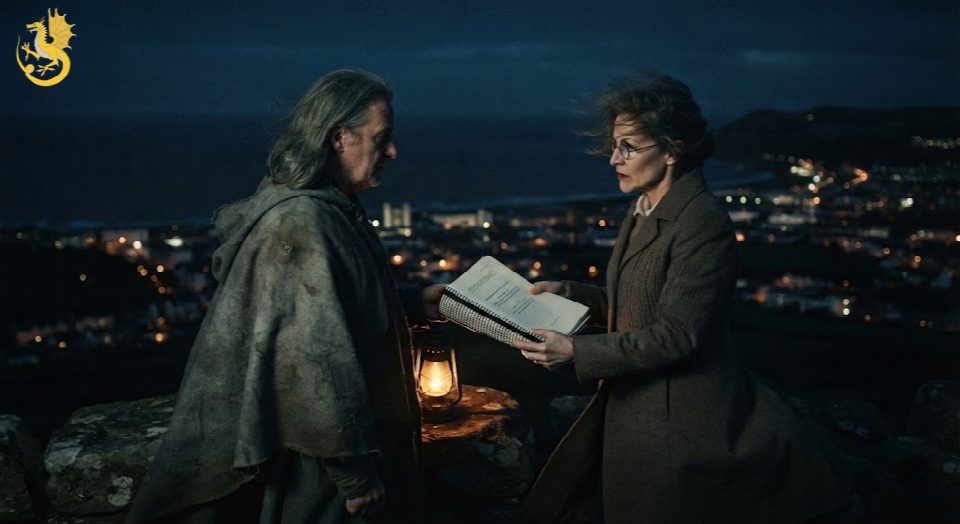
After several days spent on quieter paths, he finally met Vance in the shadow of an Iron Age hillfort overlooking Cardigan Bay.
She handed him a thick, tightly bound manuscript.
This document compiled centuries of customary tenure, charter ratifications, and pre-Conquest immunities into an argument that Vance believed could dismantle Whitehall’s case.
With this intellectual arsenal, Goldie turned southward. He eluded the watchful eyes surrounding the town and continued onward through Ceredigion.
Goldie’s Clandestine Coastal Journey to Llangrannog
Leaving Aberystwyth, Goldie steered clear of the main roads, where automated number plate recognition cameras and patrol vehicles actively searched for him.
Instead, he ventured along the rugged coastal path, tracing the edge of Cardigan Bay, where sheer cliffs plunged into the turbulent blue waters.
Freedom along the coast proved misleading. Far behind him, two figures dressed in dark, utilitarian clothing shadowed his every move from a distance.
At times, a faint mechanical whine indicated the presence of a surveillance drone above. Goldie could not discern whether it belonged to the state or its corporate partners.
He maintained his pace, using the terrain to his advantage, vanishing behind craggy headlands whenever the drone approached too closely.
After two more days navigating the coastal paths, he reached Llangrannog in the late afternoon.
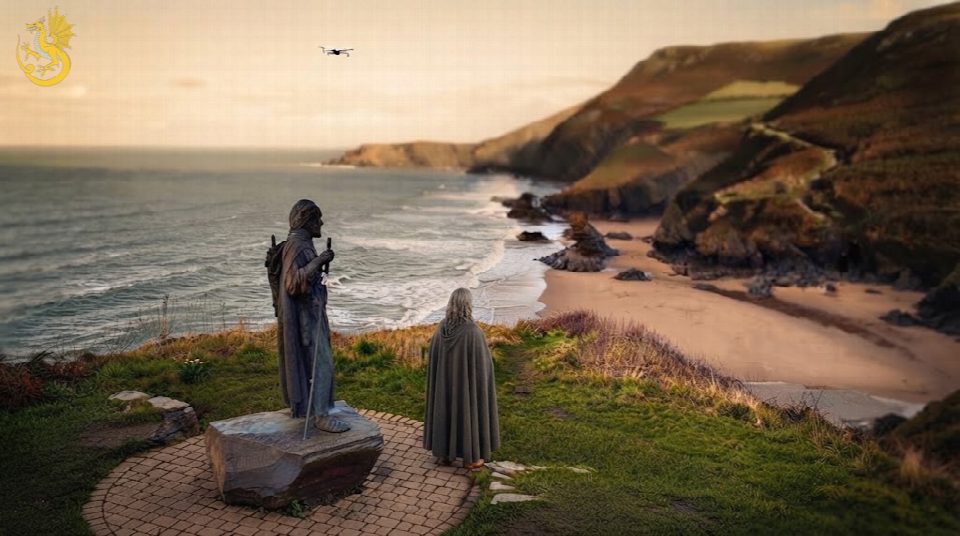
Above the beach, overlooking the crashing surf and rugged rock formations, stood the life-size bronze statue of Saint Carannog, sculpted by Sebastien Boyesen.
Goldie paused beside the statue, gazing towards the shore where, according to tradition, the sixth-century saint had arrived by sea to spread his ministry. Tradition
Navigating Enclosed Lanes and Woodland Paths
The next morning, Goldie turned inland, leaving the coastal trail for sunken country lanes bordered by ancient hedgerows of hazel and hawthorn.
These earth-worn corridors provided deep shade and a welcome refuge from the prying electronic eyes above.
Whenever the lane opened up, he slipped into peaceful woodlands, treading softly on carpets of fallen leaves and damp moss beneath dense pine and oak boughs.
Dappled sunlight filtered through the canopy. Below it, moist leaves muffled his footsteps, while intertwined branches concealed him from the sky.
He glided through the timberlands like a wraith, crossing mossy stream beds and following old paths worn into the earth.
Occasionally, the low hum of a drone drifted above the treetops. Goldie paused beneath the branches until the sound faded. Then he continued towards the tranquil valleys of his childhood.
Honouring Ancestral Connections in Glynarthen
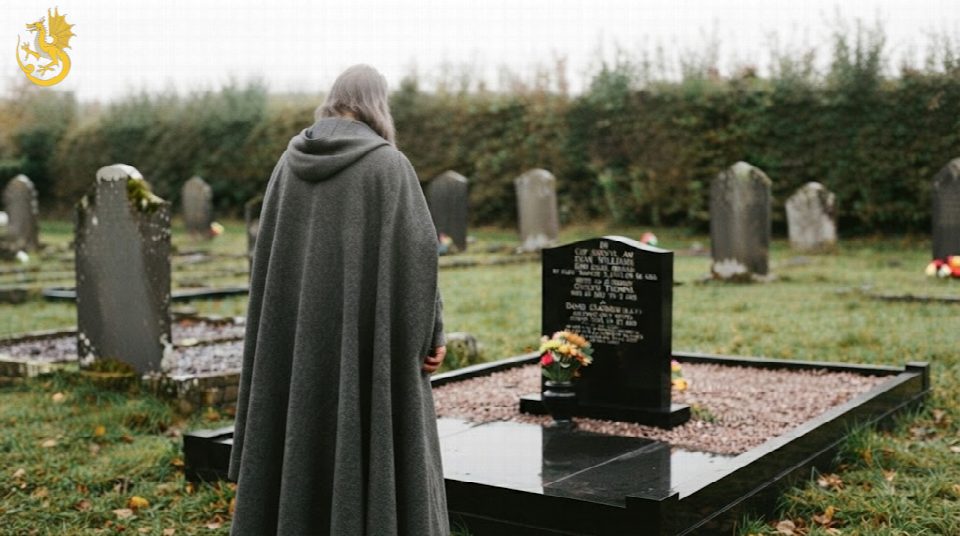
Goldie emerged from the shaded forest paths into the lush, undulating countryside surrounding Glynarthen.
For the wanderer whose mother bore the name Arianwen, this soil held sacred significance. To him, her name embodied the brilliance of white silver.
Drawing from that maternal legacy, he embraced his own moniker of gold, shaping an identity that resonated with the ancient wealth of the earth beneath his feet.
In the local churchyard rested the remains of those who had come before him.
Goldie stood beside the polished black headstone, pausing to reflect on the generations that connected his family to this land.
The church and its community held memories of both joy and sorrow.
Decades earlier, the church had celebrated a double wedding in his family. People journeyed from afar to honour two brides whose lineage, as chronicled in the family pedigree, traced back to Rhodri Mawr. Genealogies
The weight of memory lingered heavily in the soft autumn air.
Goldie traced the inscriptions with his fingers, recalling the relentless research conducted in graveyards and county record offices.
The family’s documented lineage extended thirty-five generations back to Rhodri Mawr. A handwritten family tree scroll preserved this heritage. Genealogies
In Glynarthen, amidst the quiet testament of past generations, Goldie felt the enduring presence of Lex Terrae.
The state could issue statutory writs and freeze transactions, but it could not erase the blood, sweat, and memories of families who had nurtured and defended these lands for centuries.
Here, enveloped by yew trees and inscribed granite, he offered a silent prayer of gratitude. He renewed his vow to protect the community’s customary rights against corporate encroachment.
Embracing the Heritage of Glasgoed and the Bardic Legacy
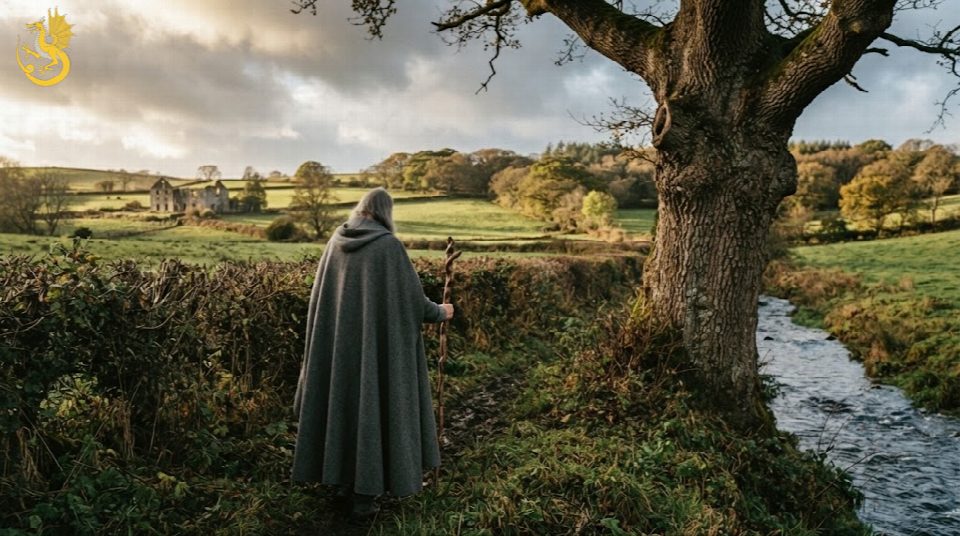
Goldie departed Glynarthen, following the sunken boundary lanes towards Glasgoed.
The old estate was intricately woven into his maternal heritage. His family’s roots ran deep in this landscape of ancient woodlands, stone-walled homesteads, and fierce self-reliance.
Glasgoed was more than just a name on an estate map; it was a place whose people and stories had been immortalised in poetry.
Dic Jones, the esteemed bard from West Wales, had captured some of its spirit through his verses.
Among the papers Goldie carried was an original handwritten copy of Dic Jones’s poem dedicated to the estate—a tangible connection between the poetic essence of Wales and the struggle unfolding around him.
As Goldie walked the perimeter of the old estate, he noted how modern agricultural intensification and absentee corporate landownership had begun to fragment the region’s historic unity.
Yet the landscape remained steadfast. Ancient oaks marked forgotten boundaries, and streams followed courses that no surveyor’s pen could straighten.
As he traversed these familiar yet long-unwalked paths, Goldie realised that the essence of Lex Terrae resided in the fields themselves.
It represented a living social contract between the inhabitants and the land. While Professor Vance’s memorandum provided the legal argument, Glasgoed offered the reason he could not simply walk away.
Every hedgerow and stone stile recalled a community shaped by tradition, cooperation, and mutual respect.
Contemplating Life at Aberporth
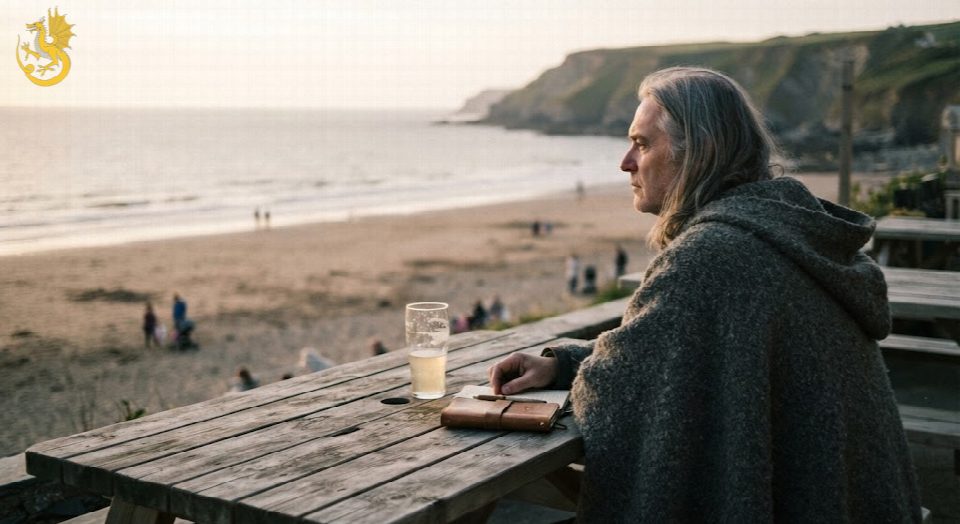
After leaving Glasgoed, Goldie turned once more towards the sea.
At Aberporth, another childhood haunt, he paused at The Ship for a refreshing pint of cider while overlooking the bay.
In the salty air, he reminisced about his younger days, filled with motorcycles, romance, and the thrill of rock music.
He contemplated his transformation into a mystic bard and questioned how life had led him to this pivotal moment.
The roar of engines and the exuberance of youth felt like a distant echo. Yet every twist and turn of his journey had guided him back to these cliffs, bound by blood and history to the land he now defended.
Ascending to the Hill of Death: The Climactic Moment
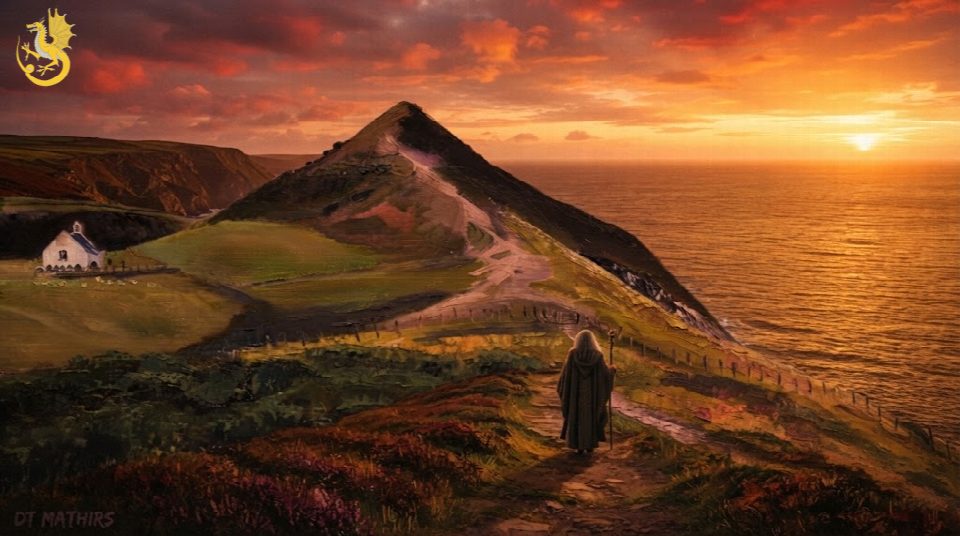
Later that afternoon, with Vance’s dossier in hand, Goldie continued towards Mwnt, where the green headland rose majestically above Cardigan Bay.
Sea-battered cliffs lined the shoreline. Below, the small, whitewashed Church of the Holy Cross nestled against the hill.
Foel y Mwnt loomed directly behind it, its grassy slopes ascending above the church and the bay.
Goldie referred to it personally as the Hill of Death.
The shore below carried memories of conflict; local tradition recounts how Welsh defenders repelled a Flemish invasion here in 1155. The bloodshed is remembered in the name Sul Coch y Mwnt—Red Sunday of Mwnt. Tradition
Goldie began his ascent as the late afternoon sun dipped towards the western horizon, casting amber light across Cardigan Bay.
The climb was physically demanding, yet he maintained a steady rhythm. His heavy grey cloak billowed in the maritime wind.
Below him, the tiny church stood resolute against the restless sea, a quiet guardian of faith and endurance.
Goldie reached the summit of Foel y Mwnt. He stood alone, caught between the roaring sea and the darkening Welsh sky.
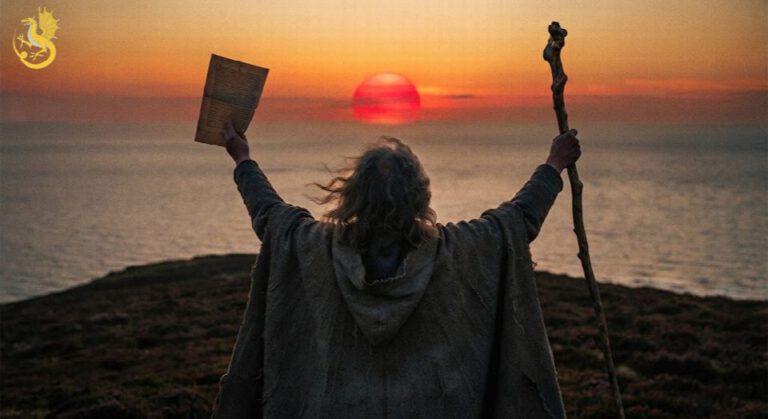
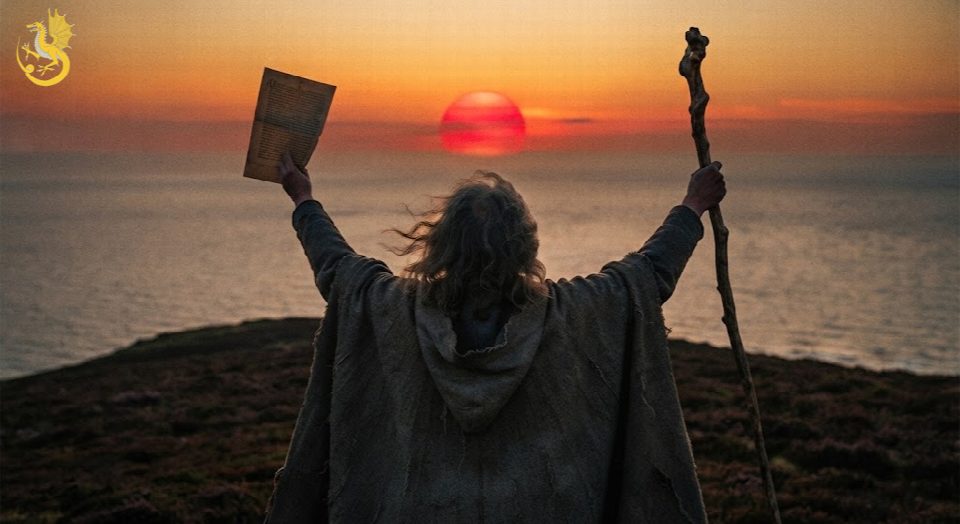
His heavy cloak enveloped him as he faced the dying sun. He raised both arms against the crimson sky, with his gnarled wooden staff in his right hand and Professor Vance’s memorandum in his left.
Before the sea and encroaching darkness, he held them aloft: one symbolising the land he walked, the other representing the cause he bore.
Crashing waves echoed far below. A fiery sunset painted the ocean in hues of crimson and gold.
With both arms raised high, Goldie offered a silent prayer, dedicating his struggle and the ancient rights of the Welsh people to divine justice and eternal stewardship.
The Tension Builds at the Church of the Holy Cross
The tranquillity at the summit shattered abruptly.
The distant rumble of engines ascended from the narrow coastal approach road.
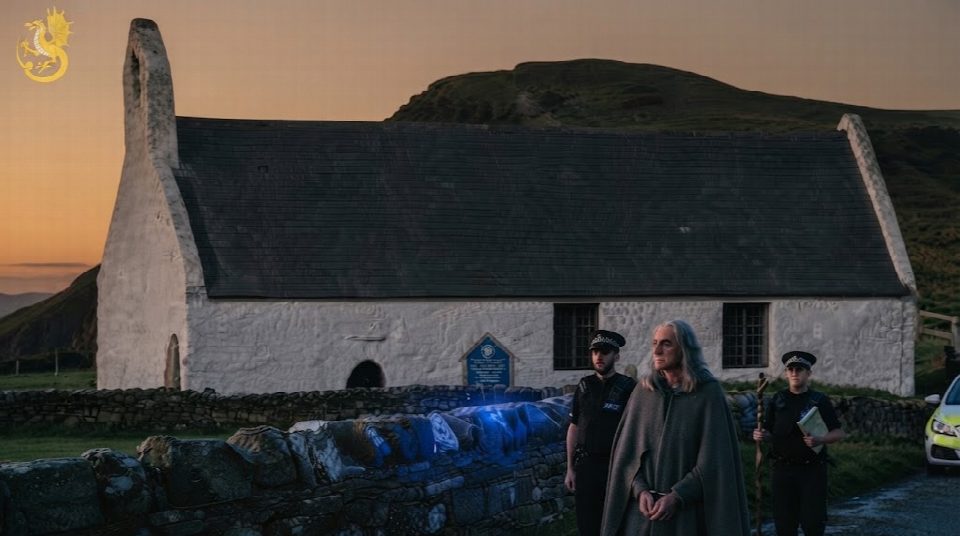
Below, several Dyfed-Powys Police 4x4s and specialised response vans came to a halt near the boundary wall of the Church of the Holy Cross.
Doors slammed shut. Officers dispersed around the approaches to the headland. A megaphone crackled to life.
“Mr Grey, this is the police. Please descend slowly and keep your hands visible.”
The amplified voice echoed across the slopes.
“You are surrounded. Comply with our instructions.”
Goldie surveyed the scene below with utter calm. He did not seek an escape through the gorse-choked gullies. He recognised that his journey on these open lands had reached its destined boundary.
Rather than waiting for the officers to reach him, he lowered his arms. Keeping his staff and Vance’s memorandum within view, he began his descent along the winding path of Foel y Mwnt.
He walked steadily towards the waiting authorities.
This was not a march to his death nor a mere surrender to temporary custody.
For Goldie, it was an act of submission to a higher authority and to the enduring will of God.
Incarceration would not silence the movement, and martyrdom was unnecessary. The truth had already taken root in the earth.
At the boundary wall of the Church of the Holy Cross, he handed an officer his staff and Vance’s memorandum.
Then he extended his hands.
The handcuffs clicked into place around his wrists.
Yet as the patrol vehicles escorted him away from the coast into the encroaching night, Goldie felt a profound sense of peace.
The parchment had been entrusted to the law.
The land had embraced its son.
The narrative of Lex Terrae was no longer his alone to bear.
Peace, Prosperity, Patience & Justice Under God.
Understanding the Distinction Between Fact and Fiction
Goldie’s journey, Professor Vance, the surveillance operation, the legal memorandum, and the arrest are all fictional. This episode draws inspiration from genuine Welsh locations, personal memories, and genealogical research.
The genealogical labels identify relationships recorded in the family pedigree, rather than independently verifying every generation. In the wedding passage, the label pertains to the ancestry documented in that pedigree, not to documentary verification of the wedding itself.
Traditional accounts are separately labelled. Personal memories and family-held material are presented as such without a documented label.
The portrayal of Lex Terrae in the story forms part of its fictional argument, rather than a statement of established legal rights.
The post Ancestors’ Path: Episode 4 Unveiled appeared first on Limits Of Strategy.