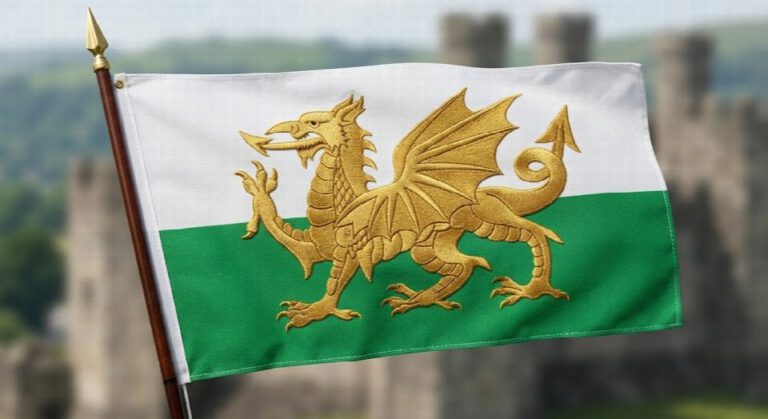
Delve into the vibrant Welsh heritage, the renowned golden dragon emblem, and a visionary outlook for Wales, which encompasses five kingdoms, fifteen castles, and a contemporary charter inspired by the Laws of Hywel Dda.

Gathering as One: The Golden Dragon as Our Symbol
Greetings, I am Goldie The Grey.
The significance of the colour gold warrants deeper exploration, while the meaning of grey is quite clear.
What does the golden dragon truly represent?
This emblem carries a rich narrative. So, pour yourself a comforting drink—coffee, tea, or perhaps something a bit stronger if that suits you. Settle in and immerse yourself in the stories I will unfold.
Embarking on the Journey of Discovery
You might imagine my story begins with a thrilling sword fight, an ancient prophecy, or a mysterious figure appearing on a tempestuous night.
In truth, it starts with the task of digitising my mother’s paperwork to preserve it for future generations.
This endeavour might seem daunting.
Family documents transform into more than mere paper. A name raises countless questions. A branch of the family tree evolves into a journey. Before long, you find yourself contemplating your lineage, reflecting on how much of your identity you understood prior to this quest.
As I progressed, the narrative expanded beyond the simple act of safeguarding my mother’s documents.
Uncovering the Names That Connect Us
In the lineage I am tracing, my family tree connects me to Rhodri Mawr, spanning thirty-five generations.
This connection deepens my understanding of my heritage. Tracing these generations is essential because a family tree signifies more than merely a line linking a monarch to a modern descendant.
Within that span are individuals.
Individuals who supported families, raised children, endured losses, and made pivotal decisions.
These lives deserve more than to be hastily overlooked in pursuit of an impressive name.
I want to learn about them too.
I strive to create space for the family narratives that do not fit neatly into a lineage chart.
The House of Rhodri, as I have come to define it, represents a truly remarkable lineage.
A Family Rich in Unique Identities
Witches, mages, shamans, seers, healers, empaths, and mystics.
These words describe the mystical lives and experiences interwoven into my family’s history.
Not everyone may choose to adopt the same terminology. Each generation likely interpreted these concepts in its unique way.
I do not suggest that every ancestor left behind a certificate to proclaim their unique role.
My mother already had more than enough paperwork.
These elements contribute to the language through which I understand our family: love, intuition, mystical practices, inspiration, care, and experiences that often require more time to articulate than to feel.
I can share these stories without expecting everyone to interpret them in the same manner.
They hold intrinsic value simply by existing.
My Personal Interpretation of Our Heritage
As for my own experiences, I describe some as shamanic and others as mage-like. Inferred
These terms resonate most closely with the message I hope to convey.
The stories behind these labels will require their own exploration. I do not wish to obscure them in borrowed mystique or imply that I have simplified something merely by labelling it as mystical.
There is space for belief here.
There is also room for inquiry.
When I share this narrative, I seek to distinguish between what I remember, what my family has shared, what I can document, and what I understand through my mystical journey.
The golden dragon can embody profound significance without needing to serve as evidence of anything.
Embracing My Kingdom and Heritage
Before anyone gets overly excited:
I am not claiming a throne.
I am claiming a kingdom.
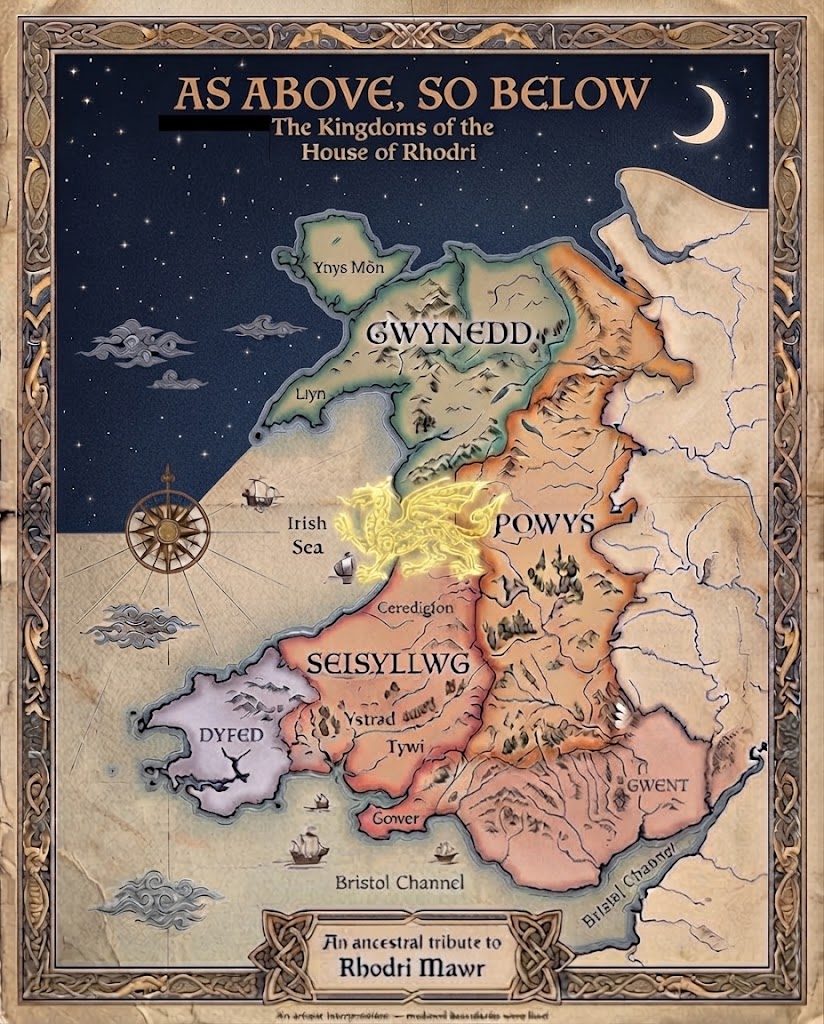
The mystical kingdom of Wales is how I refer to the enchanting landscape of this narrative: ancestry, imagination, belonging, and a vision of what is yet to be realised.
As Above, So Below.
On the map, that vision begins to take form.
Gwynedd.
Powys.
Seisyllwg.
Then Dyfed and Gwent.
Five Kingdoms, Five Colours: A Collective Vision for Wales
The map emerged from my interest in Rhodri’s realm, but the conversation did not remain confined to the past.
The family narrative extends far beyond the initial three coloured areas. As it evolved, so did the vision.
And that is the distinction I wish to clarify:
We are not simply redrawing history and acting as if it has always appeared this way.
We are envisioning a future.
Our five-kingdom map is a proposal articulated through narrative and art. Its boundaries represent the shape of an idea, rather than suggesting that every part of it was governed by a single monarch at a specific time in history.
The House of Rhodri is the title under which I am assembling this vision.
Pinpointing the Castles Within Our Vision
Then came the castles.
If we are discussing five kingdoms, we must identify the places within our vision.
Fifteen castles became our initial landmarks.
These are not the only castles in Wales, nor do they encompass the entire story. They are fifteen locations from which we can begin weaving its threads.
In our Gwynedd, we acknowledge Caernarfon, Conwy, and Harlech.
In our Powys, we recognise Powis, Montgomery, and Dolforwyn.
In our Seisyllwg, we highlight Cardigan, Dinefwr, and Carreg Cennen.
In our Dyfed, we mention Pembroke, Carew, and Manorbier.
And in our broader Gwent, we include Caerphilly, Cardiff, and Chepstow.
There they stand.
Fifteen Castles Uniting Five Kingdoms into One Vision
Within the vision of the House of Rhodri, each castle stands beneath the golden dragon.
This is their role in the narrative; not because they were all constructed by our ancestors or that their histories began with us. Each boasts its own rich heritage, and this assertion does not alter its current ownership or stewardship.
We are envisioning how these sites might belong within a collective future.
Some may enter our family story through memories, while others could connect through undiscovered links. Some might serve as spaces for us to pause, reflect, and contemplate the future we hope for Wales.
Identifying them makes this vision feel more tangible.
You might say “five kingdoms” and leave others wondering what that means.
But mention Caernarfon, Dinefwr, or Pembroke.
Suddenly, there are places to explore, questions to ask, and stories to unveil.
The map begins to resemble a journey waiting to unfold.
Which is all well and good.
Before anyone wonders where I plan to hide the keys to fifteen castles (that’s a secret!), let me remind you that this all started with the need to find a digital home for my mother’s paperwork.
We’re tackling one responsibility at a time.
Creating a Flag to Symbolise Our Vision
Next, we designed a flag to represent our vision.
For this proposed flag, we retained the white above and the green below, placing a golden dragon at the centre, replacing the red dragon. The red dragon embodies raw emotion, will, fire, and ash. In its place, we envision purpose, love, and courage.
The white signifies the heavens.
The green represents the earth.
The golden dragon embodies our hopes for Wales’ prosperity within the vision of the House of Rhodri.
To me, these colours articulate the belief that God created both the heavens and the earth. They unite the mystical with the terrestrial in a single image.
As Above, So Below.
And beneath that image, our guiding principles:
<em>Peace, Prosperity, Patience & Justice Under God.</em>
-
Peace – not a demand for uniformity, but a commitment to foster understanding without coercion.
-
Prosperity – not wealth concentrated in a few hands, but the flourishing of individuals, communities, culture, and land.
-
Patience – because a future worth building cannot be conjured into existence simply by declaration.
-
Justice – as none of the other promises hold value if individuals cannot expect fair treatment.
“Under God” expresses my unwavering faith and the sense of responsibility that accompanies it. It is not necessary for everyone to share my beliefs.
No one should be compelled to adopt a religion, accept a mystical claim, or recognise the sacredness of the dragon to enjoy equal dignity.
I would raise this flag as an invitation to reflect upon a vision.
Not as a means to silence another’s voice.
What Values Will Shape Our Kingdoms?
A map provides an excellent starting point.
But it is not enough for governance.
Eventually, someone will rightfully ask about practical implications.
What does this mean for the people living in these lands?
This is a valid question.
A golden dragon is striking, yet it cannot resolve grievances merely by shining more brightly.
The narrative requires a charter.
I do not endorse the current governmental structure as the future I envision for Wales. Yet, discontent, however intense, marks only the beginning of a conversation.
If I am to advocate for an alternative future, I must be prepared to articulate it.
This includes not only who would be central to the map.
How power would be limited.
How the voices of the people would be amplified.
How one could disagree with the House of Rhodri while remaining equally free, safe, and Welsh as anyone else.
A Contemporary Charter for Progress
As a foundation for this vision, we have chosen to draw inspiration from Cyfraith Hywel … the Laws of Hywel Dda.
This is not about a literal revival of every medieval regulation.
Rather, it is about a contemporary charter rooted in that heritage, thoughtfully examined and crafted for the people who would live under it today.
This is the proposal we are beginning to articulate.
No longer the Laws of the Sea; we demand the Laws of the Land …
Equal dignity.
Freedom of conscience.
Freedom of speech.
Leadership accountable for its choices.
Justice that strives to mend harm when possible while protecting those who have suffered.
Stewardship of the land, water, minerals, language, traditions, and places entrusted to us.
A meaningful voice for individuals across all five kingdoms.
These are commitments we must uphold in practice, not mere phrases to adorn an attractive image.
The charter must accommodate people whose beliefs diverge from mine.
There must be space for the mystic and the sceptic, for the religious and the agnostic, for those who find significance in the dragon and those who appreciate the artistry.
No one should need to share my mystical insights to possess equal rights.
Justice Within the Castles
In this envisioned future, the castles would serve purposes beyond their geographical locations.
We foresee them as homes for courts: venues where justice resonates within the communities they serve.
This would not be the existing judicial framework with a new flag draped above its entrance, but an alternative proposal whose authority stems from an agreed charter and laws openly established with the community’s consent.
Our intention is for all courts to convene in castle settings, where conservation, safety, and accessibility can align with that purpose. If a site cannot accommodate a functional court, suitable facilities must be considered without compromising the integrity of the location we aim to honour.
Because a symbol holds no value to justice if individuals cannot access it.
Judgment would be entrusted to the community; members of society under the new laws we propose.
“the community” must never become synonymous with the loudest voices within it.
A person should not lose a case due to unpopularity, unfamiliarity, poverty, or difference.
Knowing someone’s reputation must not be confused with understanding the evidence.
The charter should therefore include clear safeguards: impartial selection, the removal of anyone with conflicts of interest, independent legal counsel, and a fair opportunity for each party to be heard.
Anyone accused would be presumed innocent unless the evidence meets the legal standard. They would be entitled to understand the allegations, receive legal support, contest the evidence, and seek an independent appeal.
Those who report harm deserve safety, dignity, and support throughout the process.
Decisions must be justified.
The laws themselves should be public, comprehensible, and subject to challenge and revision through agreed procedures.
And no individual—not a leader, not a relative, not the visionary behind this concept—shall have the authority to dictate a verdict.
Including myself.
Especially if I happen to be standing beneath an especially imposing dragon at the time.
Where harm can be rectified, the court should seek meaningful restoration. Where protection is needed, it must be provided. Forgiveness may be freely offered but must never be demanded from those who have been harmed.
This is the justice I envision for these castle courts.
Not spectacle.
Not retribution.
Responsibility, equity, and a path forward.
These are proposals for a potential future, not courts we can manifest into lawful existence merely by declaring them. Until any changes are lawfully instituted, the vision will not replace existing courts or absolve anyone of their current legal responsibilities.
The Significance of a House
When I refer to a “House,” I intend for it to embody a sense of responsibility.
My lineage may shed light on why I embarked on this journey. It does not render me more valuable than those alongside me.
It does not place me above the law.
Nor can it, in isolation, grant me authority over individuals who have not consented to it.
Any future political arrangement must secure the freely expressed consent of the people, achieved through peaceful and lawful transformation.
Otherwise, we would have sketched five kingdoms without addressing the most crucial question:
Wales is already inhabited by individuals with their own lives, beliefs, aspirations, and disagreements.
A meaningful vision must encompass them.
The House, as I envision it, must be capable of listening as well as speaking.
And if its proposals cannot withstand critical examination, then those proposals require further development.
The Awakening of a Vision
When I assert that the Golden Dragon of Wales is awake, I am naming the awakening at the core of this narrative.
My growing awareness of family.
My quest for a language to articulate mystical experiences.
My desire to envision a Wales oriented around belonging, responsibility, and justice.
The dragon serves as the symbol I have chosen to encapsulate these ideals.
Its awakening does not prove that I possess all the answers.
It signals the commencement of exploring what I intend to do with these inquiries.
What does my ancestry demand of me?
What does my faith require in how I treat someone who does not share it?
What changes would I be willing to consider in my own vision after listening to another perspective?
These questions belong beneath the flag as much as any declaration.
The Current State of Our Narrative
This is where we currently stand.
A lineage being traced.
My mother’s research.
My own efforts to articulate experiences that hold significance for me.
Five kingdoms represented on a map.
Fifteen castles identified within the vision.
A proposed flag of white, green, and gold.
And the inception of a charter: a framework for discussion, testing, questioning, and improvement.
There remains much that I do not know.
This is not a reason to fabricate the missing pieces.
It is a reason to continue searching.
They call me Goldie The Grey.
The gold requires clarification.
The grey is self-explanatory.
If you arrived expecting a demand for a throne, you may need to settle for a family narrative, a proposed charter, and a rather ambitious map.
All of which originated from the need to find a digital home for my mother’s research.
Peace, Prosperity, Patience & Justice Under God.
As Above, So Below.
The Golden Dragon of Wales is Awake – Book 1
A fictional series following Goldie the Grey, the golden dragon, and a vision for Wales. Read the episodes in sequence:
The post The Golden Dragon of Wales Has Awoken appeared first on Limits Of Strategy.