
This fictional tale introduces Goldie the Grey as he challenges the Crown Estate, delving into themes of Welsh sovereignty, royal heritage, and a vision of stewardship inspired by the House of Rhodri.

This narrative is purely fictional, intricately based on actual locations and genealogical research. The evidence tags highlight specific family elements but do not authenticate the fictional events or legal claims presented.
Unpacking Welsh Sovereignty: The Clash of Lex Terrae and Westminster
Persistent rain fell over Offa’s Dyke, a reminder of an enduring grievance.
In stark contrast, across the eastern skyline, a boardroom on the fourteenth floor of a central London building appeared as a muted grey blur through its glass facade.
The hum of air conditioning filled the space, while a projector cast a faint rectangle onto the wall. Around an imposing mahogany table, individuals sat, accustomed to interpreting the world through quarterly results, carbon emissions forecasts, and marine leasing rights.
Before them lay an item that had not been anticipated on their agenda.
Not a corporate prospectus or government briefing.
Instead, it was a meticulously inked family pedigree, accompanied by a formal declaration adorned with a wax seal.
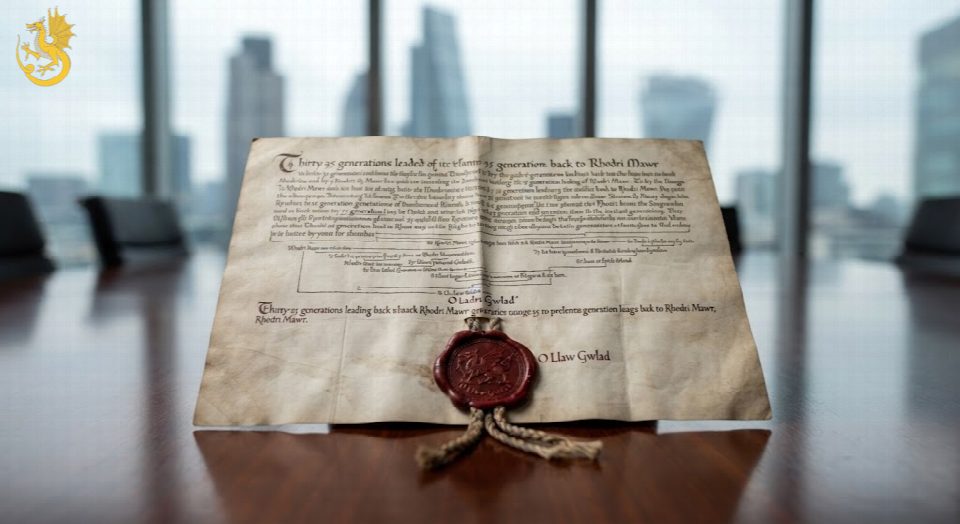
The pedigree traced thirty-five generations back to Rhodri Mawr. Genealogies
Alongside it, the declaration made a far bolder assertion: that ancestry, customary stewardship, and the collective memory of a people imposed responsibilities that contemporary institutions had overlooked.
To those gathered around the table, these documents appeared to belong to entirely different realms.
One pertained to family history.
The other challenged the frameworks through which they navigated their business endeavours.
For the individual presenting them, however, the connection was inseparable.
Revealing the Ledger of the Land: What Underlying Truths Exist?
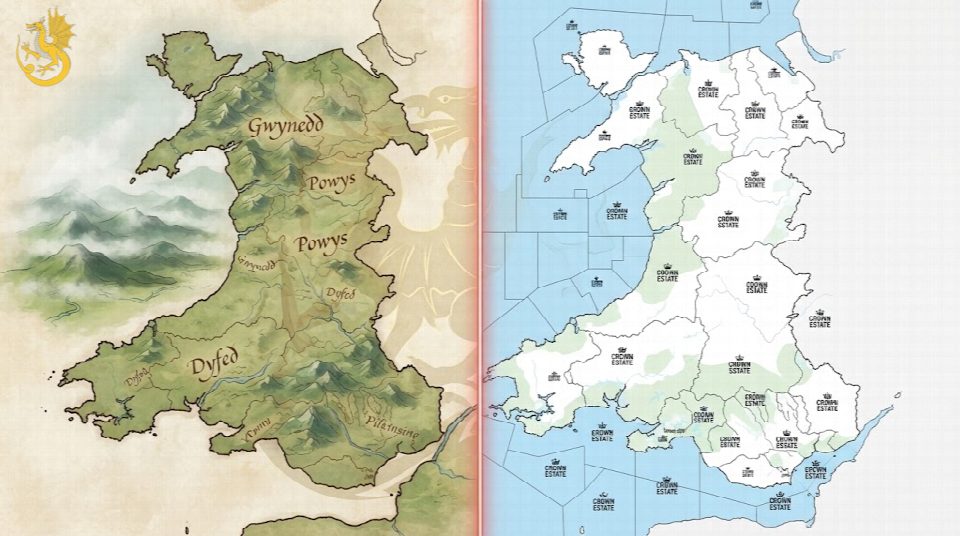
The declaration did not seek charity.
It demanded accountability.
Its author compiled references to historical laws, family records, and customary tenure under one unifying term: Lex Terrae, or the law of the land.
Goldie interpreted these words as more than just a collection of regulations. They symbolised a covenant between the people and their land, binding each generation to those who came before and those yet to come.
Flowing across the parchment were inquiries about land, foreshore, seabed revenues, and the communities inhabiting these areas.
Who benefits?
Who holds the decision-making power?
And what occurs when those entrusted with managing an estate neglect the lives that give it meaning?
The officials viewed matters of title, statute, and administration.
Goldie recognised an ancient foundation beneath a comparatively modern structure.
“You refer to parliamentary sovereignty,” he stated.
This voice emerged from beside the panoramic window.
Goldie the Grey stood, observing the traffic weave through the London haze, his heavy cloak forming an incongruous silhouette against the sleek glass.

“You treat statutes as if they are sacred scripture,” he continued. “Yet statutes are merely ink on paper, crafted by individuals who may forget whom their power is intended to serve.”
He turned towards the table.
“I have come to ask what your documentation remembers and what it has chosen to forget.”
Navigating Enclosure and Title: The Intricacies of Ownership
One of the advisers drew the declaration closer.
Goldie’s argument traversed history and personal experience. References to enclosure and shifting boundaries coexisted with memories of farms, paths, and communities.
This was not a conventional legal submission.
That was both its strength and its vulnerability.
While the advisers sought a specific interest in a defined parcel of land, Goldie articulated a relationship that spanned generations.
Where they separated ownership from access, occupation from descent, and custom from enforceable rights, he interwove those threads into a singular indictment.
The land had transformed into an asset long before it ceased to be a home.
“You cannot reduce every valley to a mere portfolio,” he asserted. “You cannot speak solely of what a lease can generate and ignore what a community stands to lose.”
A senior consultant placed his pen gently on the table.
“Nor can ownership be established merely by showcasing ancestry.”
Goldie nodded slightly.
“A family tree does not equate to a deed. I understand the distinction.”
“Then what exactly are you asking us to acknowledge?”
“That a deed does not encapsulate the entirety of a place’s history.”
For a brief moment, silence enveloped the room, punctuated only by the sound of air circulating through the ceiling vents.
Goldie placed one hand beside the pedigree.
“These names do not grant me dominion over anyone. They remind me of my responsibilities. To the land. To the people residing on it. To those who will inherit whatever legacy we leave behind.”
His gaze traversed the table.
“Where is the record of those responsibilities in your accounts?”
Drawing Connections: The Broader Pursuit of Sovereignty
Amid the documentation lay a sheet featuring place names extending beyond Wales.
Warsaw appeared alongside various cities, linked by notes concerning sovereignty, local consent, and the disconnect between institutions and the populations they govern.
To Goldie, the Welsh dilemma was part of a broader discourse.
He recognised parallels wherever communities contested decisions made far from the areas that would bear their consequences. Poland held particular significance in that imagined alliance: a nation whose history, in his view, linked the preservation of identity with the defence of self-governance.
This was an analogy, not a coalition.
No foreign government endorsed his declaration. No international authority awaited behind the wax seal.
There existed only the connection he wished his audience to contemplate.

“A community should possess a meaningful voice in shaping the future of its own home,” Goldie declared. “That question transcends the borders of Wales.”
One of the legal consultants adjusted his necktie.
“Mr Grey, regardless of your ancestry, you have yet to demonstrate a legal basis for the reversion you seek. The Crown Estate Act of 1961 and the broader framework of property law cannot simply be dismissed by declaration.”
Goldie regarded him, unfazed.
“You cannot rewrite the constitution merely by placing a parchment on the table,” the consultant added.
A wry smile briefly crossed Goldie’s face.
“No, but I can present a question that you would prefer to remain unasked.”
“And if a court dismisses your argument?”
“Then you will have addressed a legal claim. You will not necessarily have addressed the people who posed it.”
A Bardic Appeal for Recognition
The consultant leaned back in his chair.
Goldie pulled the declaration closer and smoothed its edge with his palm.
“We are not here to plead for scraps from the table.”
His tone remained calm, yet the rhythm shifted. Each sentence resonated with the deliberate cadence of a recital.
“We are here to question who set the table, who provided the feast, and why so many of our communities remain outside the door.”
A junior adviser glanced towards the chair of the meeting.
No one interrupted.
“Let the revenues generated from our coastline support the people who inhabit it. Let decisions regarding the land acknowledge those who must endure its consequences. Let stewardship encompass more than profit extraction, allowing others to tally the cost.”
He paused.
“I invoke the spirit of the ancient laws not to ensnare Wales in its past, but because I refuse to accept that its future must be dictated elsewhere.”
The chair lowered his gaze to the seal.
“What do you expect us to do with this?”
“Read it. Respond to it. And recognise that this is not the sole copy.”
A brief, nervous chuckle escaped from the far end of the table.
It found no resonance.
The chair closed the folder.
By the time Goldie exited the room, someone had already been tasked with preparing a briefing. Another adviser was making a call from the corridor.
His claims had not been validated.
His declaration had not gained new legal standing.
Yet it would not be quietly disregarded.
The Golden Dragon Awakens
Outside, London continued its rhythm around him.
Buses splashed against wet kerbs. Office workers hurried beneath umbrellas. Beyond the boardroom windows, nothing seemed to have changed.
Goldie paused briefly in the rain.
The pedigree remained a record of family lineage, bearing its own inquiries and uncertainties.
The declaration, however, represented something altogether different.
It constituted a demand that others would contest, scrutinise, dismiss, or advance.
He had unified the two because, to him, memory engendered responsibility. Whether others acknowledged this connection was now beyond his influence.
Behind him, the initial calls began ascending the chain of command.
Ahead lay the journey back to Wales.
Goldie tightened his cloak and stepped into the bustling city.
In his mind, the golden dragon was no longer dormant under the weight of ancient tales.
It had opened its eyes.
Peace, Prosperity, Patience & Justice Under God.
Distinguishing Between Fact and Fiction
Goldie, the boardroom meeting, the submission of the declaration, and the ensuing dialogue are fictional. The officials and advisers are entirely fictional characters and do not represent identifiable individuals.
This narrative draws inspiration from family research and employs real locations, institutions, and legislation as the backdrop for a fictional conflict.
The genealogical label signifies a relationship documented in the family pedigree. It does not independently verify every generation, establish continuous occupation, or demonstrate present-day ownership or sovereignty.
Goldie’s interpretation of Lex Terrae articulates his fictional moral and political stance. Ancestry is not posited here as evidence that existing titles or legislation can be overturned.
The Polish comparison reflects Goldie’s viewpoint within the narrative. It does not imply endorsement from any actual government, organisation, or community.
No Documented label is applied to the fictional events or legal arguments.
Continue the Journey with the Next Chapter
The post The Parchment and the Crown: Episode One Unveiled appeared first on Limits Of Strategy.