
Discover the intriguing ancestral link between Edmund Tudor and the House of Rhodri through our shared Welsh heritage, Margaret Beaufort, and an intertwined family lineage.

Unveiling My Fascination with Margaret Beaufort and Our Family Tree
My exploration of Tudor family history began unexpectedly.
While scrolling through Facebook, I encountered a moving story about a young girl giving birth at Pembroke Castle.
This girl was none other than Margaret Beaufort, who, at just thirteen years old, had already lost her husband. The child she bore would grow up to be Henry VII.
Among the details of this tale, one name resonated deeply with me.
Edmund Tudor.
He was the father of this remarkable child.
Could this hint at a connection to our own family history?
Once again, I retrieved the family tree.
How a Surprising Story Sparked My Research Journey
Researching family history often begins in unexpected ways, ignited by chance encounters.
Sometimes, you trace a name through numerous records. At other times, you find yourself struggling to decipher scrawled handwriting that seems determined to keep its secrets hidden.
A casual scroll through social media might lead you to another person’s story, igniting a flame of curiosity within you.
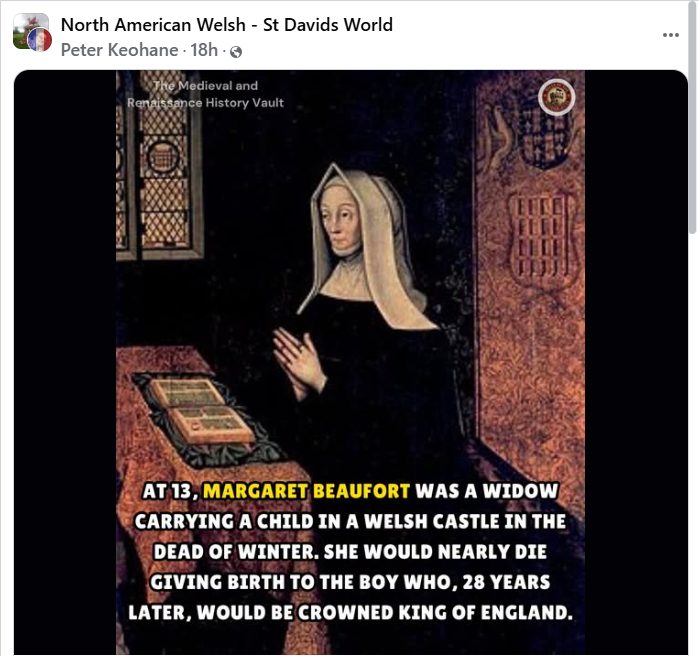
The Facebook Post That Inspired My Research
This moment marked my first introduction to the story of Margaret Beaufort and the birth of Henry Tudor.
The post narrated the tale with dramatic intensity: a winter birth, a young mother, a deceased husband, and a child born into precarious circumstances.
It’s important to understand that while this post sparked my interest, it did not serve as the foundation of historical fact.
A compelling story can inspire deeper investigation, but it does not automatically validate every detail simply due to its emotional resonance.
Still, it compelled me to reflect significantly.
Margaret Beaufort: The Young Mother at Pembroke Castle
On 28 January 1457, Margaret Beaufort gave birth to Henry Tudor at Pembroke Castle.
At that moment, she was only thirteen years old.
Tragically, her husband, Edmund Tudor, had passed away before their child’s birth, leaving Margaret to be supported by Edmund’s brother, Jasper Tudor.
These facts warrant thoughtful consideration.
Before the titles, battles, portraits, and intricate family trees, there was a young girl facing the challenges of childbirth without her husband’s presence.
It’s easy to overlook her story simply because we know the illustrious future awaiting her son.
Henry VII, the first Tudor king.
Margaret didn’t simply conclude a chapter in a history book.
She brought a new life into the world.
Recognising the conclusion can sometimes obscure the uncertainty surrounding the beginning.
How to Distinguish Fact From Assumption
The narrative I encountered depicted a scene with snow blanketing the castle, suggesting that few anticipated the child’s survival.
While these details paint a vivid picture, they must be substantiated before I can label them as facts.
The same caution applies when discussing Margaret’s health. Various accounts suggest a difficult birth, and Henry was her only child. the absence of further children does not provide a medical record explaining what transpired or why she did not have more.
I hesitate to replace uncertainty with certainty just because a statement carries emotional weight.
Margaret’s story is substantial enough without embellishment.
Her youth, her status as a widow, and the birth of her son provide ample significance.
The goal is to tell this story sensitively while remaining aware of the difference between evidence and speculation.
The Name That Inspired My Research
It was Edmund’s name that prompted me to revisit the family tree after seeing the Facebook post.
I was familiar with the overall trajectory of our genealogical exploration: tracing Welsh princely lines back to Rhodri Mawr, with connections through the families of Deheubarth and Gwynedd.
This, however, did not answer my specific question.
Is there a connection between Edmund Tudor and our family lineage?
A shared interest in Welsh ancestry does not necessarily imply a familial bond.
Nor does a familiar surname guarantee a relationship.
I needed a concrete link: an individual or couple whose descendants could be traced in both directions.
So, I commenced my inquiries.
Then, I retrieved the family tree document.
Identifying Key Figures in Our Family Tree
Within the central section of our lineage, I discovered names that sharpened my investigation.
Ednyfed Fychan. Genealogies
And his wife, Gwenllian, daughter of the Lord Rhys. Genealogies
The chart outlines the lineage through Gruffydd ap Rhys and his wife Gwenllian, followed by their son Rhys ap Gruffudd, known as the Lord Rhys.
It continues through his daughter Gwenllian, who married Ednyfed Fychan.
Then it traces another Gwenllian: their daughter, noted as the spouse of Gwrwared ap Gwilym.
This is the branch our chart follows through the family.
It’s important to pause and reflect on this.
There is more than one Gwenllian in this narrative, and conflating them could lead to misleading connections based on incorrect individuals.
Genealogical research rewards meticulousness.
It prioritises diligence over enthusiasm.
Unfortunately, enthusiasm often takes precedence.
Investigating the Tudor Lineage
Records of Tudor ancestry also link the family to Ednyfed Fychan and Gwenllian, daughter of the Lord Rhys.
Their descendants included the Tudors of Penmynydd.
From this family came Owain Tudor, also known as Owen Tudor.
Edmund was the son of Owain and Catherine of Valois.
And Edmund’s son, born at Pembroke to Margaret Beaufort, was Henry Tudor.
Suddenly, my inquiry gained clarity.
Our family tree followed one branch from an ancestral couple.
The Tudor lineage traced a different path.
This does not imply that Edmund was my direct ancestor. Inferred
It suggested a collateral connection: a relationship through shared ancestry, rather than a direct line descending from Edmund himself.
This distinction makes the discovery even more compelling for me.
I do not need to transform every connection into a direct lineage to a notable figure.
The branching aspect is what matters.
Insights from Our Family Chart
Our family chart documents a specific lineage.
This bears significant importance.
It outlines the relationships detailed in the pedigree and offers a pathway for further research.
It does not independently confirm every relationship recorded within it.
To accurately establish the connection, each generation must be verified against supporting sources. The intermediary Tudor links require clear articulation, as does our own lineage.
At this point, we cannot definitively assign a cousin relationship to Edmund.
Nor should we assert that sharing medieval ancestors automatically conveys modern entitlement.
What we can assert is more measured:
Our documented lineage includes the ancestral couple linked to the Tudor connection, providing a specific avenue for investigation.
This is a significant outcome stemming from a question prompted by a Facebook post.
Margaret Beaufort: A Multifaceted Figure Beyond Motherhood
It would be a disservice to reduce Margaret to the role of a mother in childbirth.
She lived for over fifty years after Henry’s birth.
Her life was filled with marriage, property management, political negotiations, religious devotion, and relentless advocacy for her son.
When Henry ascended to the throne in 1485, it was not merely the culmination of a destiny expected for a vulnerable infant.
It was the result of years of conflict, shifting circumstances, and alliances in which Margaret played a pivotal role.
Her subsequent marriage to Thomas Stanley is part of this political narrative, as is her collaboration with Elizabeth Woodville.
Margaret was not a passive bystander waiting for history to unfold.
She actively contributed to shaping it.
This deserves recognition without transforming her into an omnipotent figure orchestrating every outcome.
Witnessing the Crowning of Two Generations of Monarchs
Margaret lived to see her son become Henry VII.
She also witnessed her grandson ascend the throne as Henry VIII.
She passed away in June 1509, shortly after the younger Henry’s coronation.
There’s a poignant contrast between these moments: the young mother at Pembroke and the older woman who witnessed both her son and grandson crowned.
Yet, I aim for precision in my wording.
To claim she lived to see three generations of her descendants crowned would be misleading.
She witnessed two.
Later generations constitute part of the ongoing Tudor narrative, not events she personally experienced.
A story does not lose its significance when we accurately recount its details.
Why Pembroke Castle Holds Greater Significance Today
Pembroke Castle was already one of the fifteen castles integral to my vision of a five-kingdom Wales.
This investigation grants me another reason to cherish it.
Not because this discovery validates ownership.
Not because every individual whose lineage intersects with mine becomes part of a claim.
Locations gain meaning as we begin to comprehend the lives intertwined with them.
For me, Pembroke is now a site where numerous questions converge.
Margaret’s narrative.
Edmund’s lineage.
Henry’s origins.
And the potential connection between the Tudor branch and the names documented in our own lineage.
The castle remains unchanged.
What I bring to it has transformed.
A New Branch to Explore
This is where the story currently stands.
A Facebook post inspired an inquiry.
A name led me back to the family tree.
The chart unveiled a potential connection.
Research is ongoing.
Perhaps this comprehensive work will allow us to clarify the relationship accurately. Perhaps it will also reveal necessary corrections along the way.
Either outcome holds value.
I prefer to understand the family truthfully rather than embellish it with connections I cannot substantiate.
For now, I can state the following:
I sought to determine if Edmund Tudor was linked to our family.
I found a shared ancestral path worth exploring and a reason to delve deeper into the life of the young woman who gave birth at Pembroke.
Countless names populate a family tree.
Sometimes, it requires another’s story to encourage us to pause at just one.
I Wasn’t Looking For The Tudors.
But Edmund’s Name Led Me Back To The Tree.
Clarifying the Research Process
This narrative distinguishes the family pedigree from independently verified ancestry. The proposed connection through Ednyfed Fychan and Gwenllian ferch Rhys remains to be validated through individual generations.
The Facebook post is noted as the catalyst for this exploration, rather than as proof of its historical or genealogical claims. Inferred
Recommended Further Reading
-
Margaret Beaufort, Countess of Richmond — Westminster Abbey
An overview of Margaret’s life, family, educational foundations, and her burial at Westminster Abbey. -
The Birthplace of Henry VII — Pembroke Castle
The castle’s account of Henry’s birth, Margaret’s arrival under Jasper Tudor’s care, and research into the likely location of the birth. -
Inside the Tudor Stronghold of Pembroke Castle — History Answers
Further historical and archaeological context for Pembroke Castle and its association with the Tudor family.
These sources provide historical context. They do not independently establish the proposed connection between our family pedigree and Edmund Tudor.
The post Edmund Tudor: Exploring His Welsh Connection to House of Rhodri appeared first on Limits Of Strategy.
References:
Edmund Tudor: Exploring His Welsh Connection to House of Rhodri