Essential Electrical Specifications for Induction Cooktops in Queensland
Are you in the process of selecting an induction cooktop for your home in Queensland? Understanding the specific electrical requirements is vital before making a decision. Induction cooktops function differently from traditional gas or electric models, which makes it essential to focus on the necessary wiring upgrades.
In Queensland, most induction cooktops require a dedicated 230-240V circuit, with many models operating on 20 to 32 amps. This means your existing wiring may need to be upgraded to safely support this power demand.
The power needs for your induction cooktop will largely depend on two main factors: the total kilowatt rating of the model you choose and whether your property uses single-phase or three-phase power. Having this information ready before you make a purchase is crucial.
Some high-end induction cooktops may require three-phase power, operating at 380-415V AC at 50Hz. This type of power supply is not commonly found in residential settings, so always check the specifications of your chosen model. A licensed electrician can evaluate your switchboard and wiring, providing recommendations for any necessary upgrades before installation.
Frequently Asked Questions About Induction Cooktops
Below are common questions we receive, along with straightforward answers from our certified electricians:
| Question | Quick Answer |
|---|---|
| Is three-phase power essential for all induction cooktops? | Most residential setups do not require it. Only high-end or larger models (typically over 7.4kW) may need three-phase power. |
| What type of wiring is needed for an induction cooktop? | A dedicated circuit with either 6mm² or 10mm² cabling, depending on the amperage and the length of the cable run. |
| What is the usual amp draw of an induction cooktop? | Most induction cooktops draw between 20-32 amps. Always refer to the product specifications for confirmation. |
| What size circuit breaker should I use? | A 32-amp breaker is generally needed for standard residential models. |
| What cable size is suitable for an induction cooktop? | Usually, 6mm² cable suffices for 32 amps. Longer cable runs may require 10mm² wiring. |
| Can I simply plug in an induction cooktop? | Portable models can be plugged in, but built-in models must be hardwired by a licensed electrician. |
| Is a safety switch mandatory for induction cooktops? | Yes. The circuit must include RCD protection at the switchboard, and an isolation switch should be located close to the cooktop. |
| Can my existing switchboard support an induction cooktop? | Only if it has spare capacity, effective RCD protection, and sufficient overall capacity. An electrician will assess your switchboard before providing a quote. |
Ensuring Safe and Professional Installation of Induction Cooktops
In Queensland, a licensed electrician must perform the installation of built-in induction cooktops. Most units require a dedicated circuit designed to meet their specific power needs.
A qualified electrician will:
- Inspect your home’s current wiring
- Ensure the switchboard has spare capacity and operational RCD protection
- Create the dedicated circuit leading back to the switchboard
- Install an isolation switch
- Add surge protection to shield against power spikes
- Confirm adherence to Australian electrical standards
Installation costs will depend on your current setup and any necessary upgrades. Your electrician will inform you on-site about any additional cabling or switchboard enhancements that may be needed.
Is My Switchboard Capable of Supporting the Induction Cooktop Load?
The answer varies based on several key factors that your electrician will evaluate before proceeding with any orders.
- Spare capacity. The new dedicated circuit will require its own breaker, which necessitates available space on the switchboard.
- RCD protection. The cooktop circuit must include a safety switch. Older switchboards may lack this protection or may only cover specific areas of the house.
- The condition of the switchboard. If it has ceramic fuses or heat-damaged wiring, it may need replacing rather than just upgrading.
- The power supply into the house. The mains and main switch must be able to handle the new load along with existing appliances.
A full switchboard upgrade isn’t always necessary. Many switchboards have spare capacity and are in good condition, meaning only the new circuit may be needed.
Transitioning from Gas Cooking to Induction Cooktops
This transition can often catch homeowners off guard. Kitchens that have relied on gas typically do not have a dedicated cooking circuit behind the cooktop; they usually only have a power point for ignition. This makes it impossible to plug in an induction cooktop.
The necessary electrical work includes running a new dedicated circuit from the switchboard to the cooktop. This circuit must be equipped with its own breaker, RCD protection, and an isolation switch. Access to the wall or ceiling for cabling may be required, so ensure this is arranged before the cabinetmaker begins their work.
Disconnecting and capping the old gas supply is a separate licensed task. Our team will manage the electrical aspects, which usually constitute the larger portion of the work during this transition.
How Induction Cooktops Function
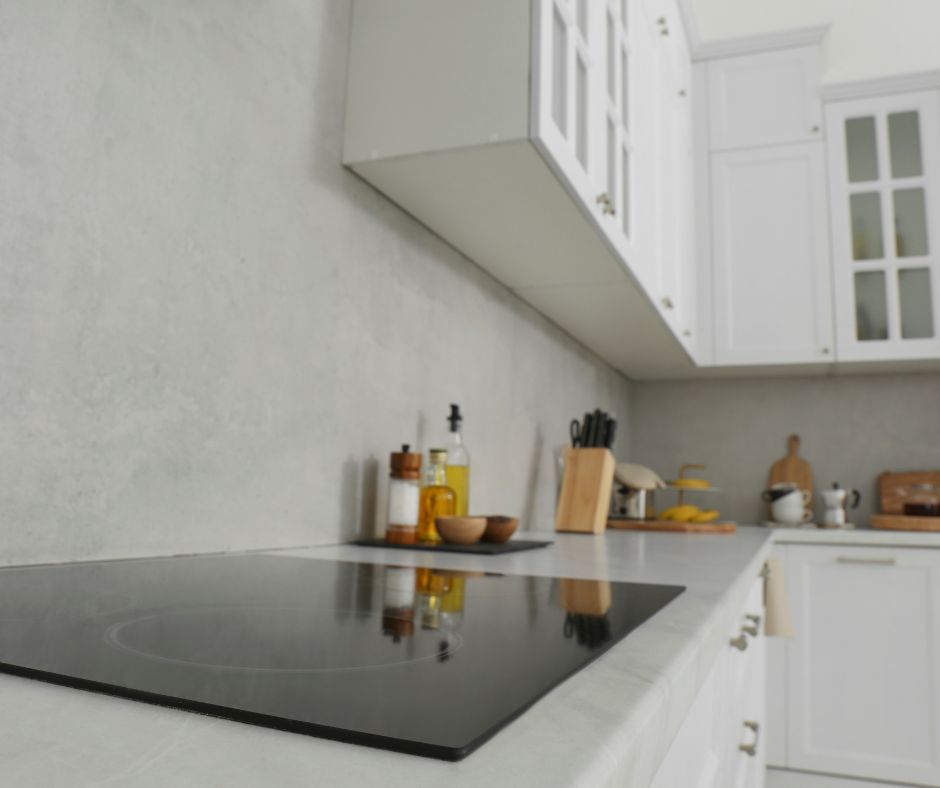
Induction cooktops utilise a magnetic field rather than relying on a hot element. This technology enables faster heating, greater efficiency, and a safer alternative compared to conventional electric or gas cooktops, offering enhanced control over cooking temperatures.
The Basic Principle of Induction Cooking
Copper coils beneath the ceramic glass generate a magnetic field. When compatible cookware is placed on top, this field transfers energy directly into the pot or pan.
The pan itself becomes the heat source while the glass surface stays relatively cool. This efficient energy transfer results in minimal heat loss compared to other cooking methods.
Only magnetic cookware, such as cast iron or certain stainless steel types, is suitable for induction cooking. A simple test is to see if a fridge magnet sticks to the bottom of the pan; if it does, it will work with induction.
The Rising Popularity of Induction Cooktops
Induction technology heats pans more quickly than traditional electric elements. When you reduce the heat, the response is equally fast.
The surface remains cool to the touch, making it a safer choice for families with children. Spills do not stick, allowing for easy and quick cleaning.
Induction cooktops are also more economical to operate. They focus most of their energy on the cookware rather than heating the surrounding air, thus reducing energy costs.
You also gain precise control over temperature settings. The heat adjusts in small increments, which is particularly helpful for delicate tasks like melting chocolate or sustaining a gentle simmer.
Electrical Wiring Standards for Induction Cooktops in Queensland
To ensure safe operation, an induction cooktop must connect to the correct electrical setup. Adhering to the right circuit, breaker, and cable specifications will guarantee reliable performance for years to come.
Voltage and Frequency Requirements
Most induction cooktops operate on standard single-phase power: 220-240V AC at 50Hz, which is typically available in Queensland homes.
Certain high-end models may require three-phase power at 380-415V AC, 50Hz, although these are more commonly found in commercial kitchens than in residential settings.
The power rating of the cooktop determines the type of supply needed. Most residential units range between 3.7kW and 7.4kW and operate efficiently on single-phase power.
Dedicated Circuit and Circuit Breaker Specifications
An induction cooktop requires its own dedicated circuit, ensuring that no other appliances share that line.
A licensed electrician will install a circuit breaker designed for your cooktop’s specifications. Most residential units typically require:
- A 20-32 amp circuit breaker
- Heavy-duty cabling
- Direct hardwiring back to the switchboard
Safety Switch (RCD) at the Switchboard
The cooktop circuit must include RCD protection, provided by the safety switch on your switchboard. This device disconnects power if current leaks to earth, ensuring safety for users rather than just protecting the appliance.
The RCD is separate from the isolation switch on the wall and distinct from the circuit breaker. Many older switchboards lack RCD protection or only cover certain outlets, so this must be addressed during the cooktop installation.
Isolation Switch (Kill Switch)
To comply with Australian electrical standards (AS/NZS 3000:2018 Wiring Rules), a dedicated isolation switch must be installed near the cooktop. This switch allows for quick power disconnection in emergencies or during maintenance. It should be easily accessible, typically within two metres of the cooktop but positioned away from direct overhead placement or difficult access.
Adhering to Standards and Regulations
All installations must comply with the AS/NZS 3000 Wiring Rules. There must be a minimum clearance of 50mm from the front edge of the benchtop to the cooktop cut-out.
A surge arrestor is essential for protecting the cooktop’s electronics from power spikes. Many manufacturers require the installation of a surge arrestor to maintain warranty coverage.
After installation, your electrician must provide a Certificate of Compliance, which serves as proof that the work meets Queensland safety standards and building codes.

Key Considerations for Induction Cooktop Installation
Installing an induction cooktop necessitates careful planning concerning both wiring and the physical space it occupies. Ensuring proper clearances will enhance the unit’s performance and longevity.
Selecting Between Built-In or Portable Models
A portable single-zone induction cooktop can be plugged into a standard power point without requiring electrical installation. This is the only type you can set up independently.
Conversely, a built-in cooktop must be hardwired to its own circuit by a licensed electrician. It cannot connect to a standard power point or an extension lead.
Ventilation and Clearance Requirements
Proper ventilation is crucial for an induction cooktop to function effectively. Adequate clearance allows heat to dissipate, preventing the underlying electronics from overheating.
Required Clearances:
- Front: At least 50mm clearance between the front edge of the benchtop and the cooktop cut-out.
- Base: At least 100mm clearance between the cooktop base and any safety barrier.
- Overhead: Sufficient space for the rangehood, following the manufacturer’s specifications.
- Sides: Follow the manufacturer’s guidelines for side spacing.
Maintaining good airflow around the unit enhances its performance and durability. Some models may require additional space beneath for cooling, with specifications varying from one cooktop to another. Always consult the manufacturer’s recommendations before making adjustments to cabinetry.
Boosting Energy Efficiency and Reducing Operating Costs
Induction cooking offers an economical solution for Queensland households, leading to lower power bills over time.
Understanding Power Consumption
Since heat is directed straight into the pan, minimal energy is wasted heating the surrounding air. The power draw at any given moment depends on the number of cooking zones being used and their specific settings.
The key figure for wiring considerations is the total kilowatt rating displayed on the compliance plate. This rating guides the circuit sizing.
Comparing Efficiency with Traditional Cooking Methods
Traditional electric elements must first heat themselves before warming the pan. Induction technology eliminates this step since the pan itself acts as the heating element, resulting in less energy wasted in heating the cooktop.
Very little heat escapes into the room, as the surface stays cool. This keeps the kitchen environment comfortable and reduces the load on air conditioning during the hot Queensland summers.
Water boils more quickly on induction cooktops.
Comprehensive Answers to Your Induction Cooktop Queries
What electrical specifications are required for an induction cooktop in Queensland? Most residential induction cooktops in Queensland need a dedicated circuit with a 240V single-phase supply, drawing between 20 and 32 amps. The installation must include its own breaker, RCD protection at the switchboard, an isolation switch within two metres of the cooktop, surge protection, and must be hardwired by a licensed electrician. All installations must comply with the AS/NZS 3000:2018 Wiring Rules.
What is the typical amp consumption of an induction cooktop? Most residential induction cooktops draw between 20 and 32 amps at full load. A standard 60cm four-zone cooktop generally requires a 32-amp dedicated circuit. Always verify your model’s specifications, as power requirements can vary from 3.7kW to 7.4kW for single-phase residential units.
What size circuit breaker is necessary for an induction cooktop? Typically, a 32-amp breaker is required for most standard residential cooktops on a dedicated circuit. Your electrician will confirm the appropriate breaker size based on your specific model and cable run length.
What cable size is suitable for an induction cooktop? Generally, a 6mm² cable is appropriate for a standard 32-amp induction cooktop circuit. For longer cable runs from the switchboard to the cooktop, a 10mm² cable may be necessary to prevent voltage drops. Your electrician will determine the correct size based on your kitchen layout.
Is three-phase power necessary for induction cooktops? Most homes in Brisbane do not require it. Single-phase power is sufficient for the majority of residential models up to 7.4kW. Only high-end or larger cooktops, typically above 7.4kW, require three-phase power at 380 to 415V. Always check your model’s specifications or consult a licensed electrician.
Can my existing switchboard support an induction cooktop? Only if it has spare capacity for the new breaker, functional RCD protection, and adequate capacity on the mains. Older switchboards with ceramic fuses or lacking safety switches may need upgrades. Many switchboards are suitable and will only require the addition of the new circuit.
Is a safety switch required for an induction cooktop? Yes. The cooktop circuit must be RCD protected at the switchboard. The RCD is designed to trip when current leaks to earth, ensuring safety for the user. This is separate from the circuit breaker and the isolation switch on the wall.
Is an isolation switch necessary for an induction cooktop in Queensland? Yes. According to AS/NZS 3000:2018 Wiring Rules, a dedicated isolation switch must be installed near the cooktop, typically within two metres for easy access. This allows for quick power disconnection during emergencies or maintenance.
What electrical work is needed to replace a gas cooktop with an induction model? In most cases, a new dedicated circuit is required. Kitchens that have exclusively used gas typically do not have a cooking circuit behind the cooktop, only a power point for ignition. This means a cable must be run from the switchboard with its own breaker, RCD protection, and an isolation switch. Disconnecting the old gas supply is a separate licensed job.
Can I install an induction cooktop myself in Queensland? No. A built-in induction cooktop must be hardwired by a licensed electrician in Queensland. DIY electrical work is illegal and unsafe, potentially voiding the cooktop’s warranty. Your electrician will also provide a Certificate of Compliance upon completion, confirming that the installation meets Queensland safety standards.
Does an induction cooktop need surge protection? Yes. A surge arrestor is necessary to protect the cooktop’s electronics from power spikes, and many manufacturers mandate its installation for warranty coverage. Your electrician will include this as part of the dedicated circuit setup.
What is the cost of installing an induction cooktop in Brisbane? Installation costs vary based on your home’s existing setup. If the switchboard has spare capacity and the kitchen is conveniently located, costs will be lower. New cabling, switchboard upgrades, or three-phase power requirements can increase expenses. A licensed electrician can provide a fixed quote after assessing your home.
What clearances are necessary for an induction cooktop? Ensure at least 50mm of clearance between the front edge of the benchtop and the cooktop cut-out, a minimum of 100mm between the cooktop base and any safety barrier, and sufficient overhead space for the rangehood. Side clearances vary by brand, so always consult the specifications before making modifications to cabinetry.
Are you planning to install an induction cooktop in Brisbane? Contact Precision Electrical & Air at 0423 163 359. We will manage the circuit setup, isolation switch installation, and compliance certificate, ensuring everything is completed accurately. Induction Cooktop Installation Brisbane
Original Article First Published At:
The Article: Induction Cooktop Electrical Requirements in Queensland: Wiring & Amps first appeared on https://writebuff.com
The post Induction Cooktop Electrical Requirements for Queensland Wiring appeared first on Limits Of Strategy.
References:
Induction Cooktop Electrical Requirements for Queensland Wiring